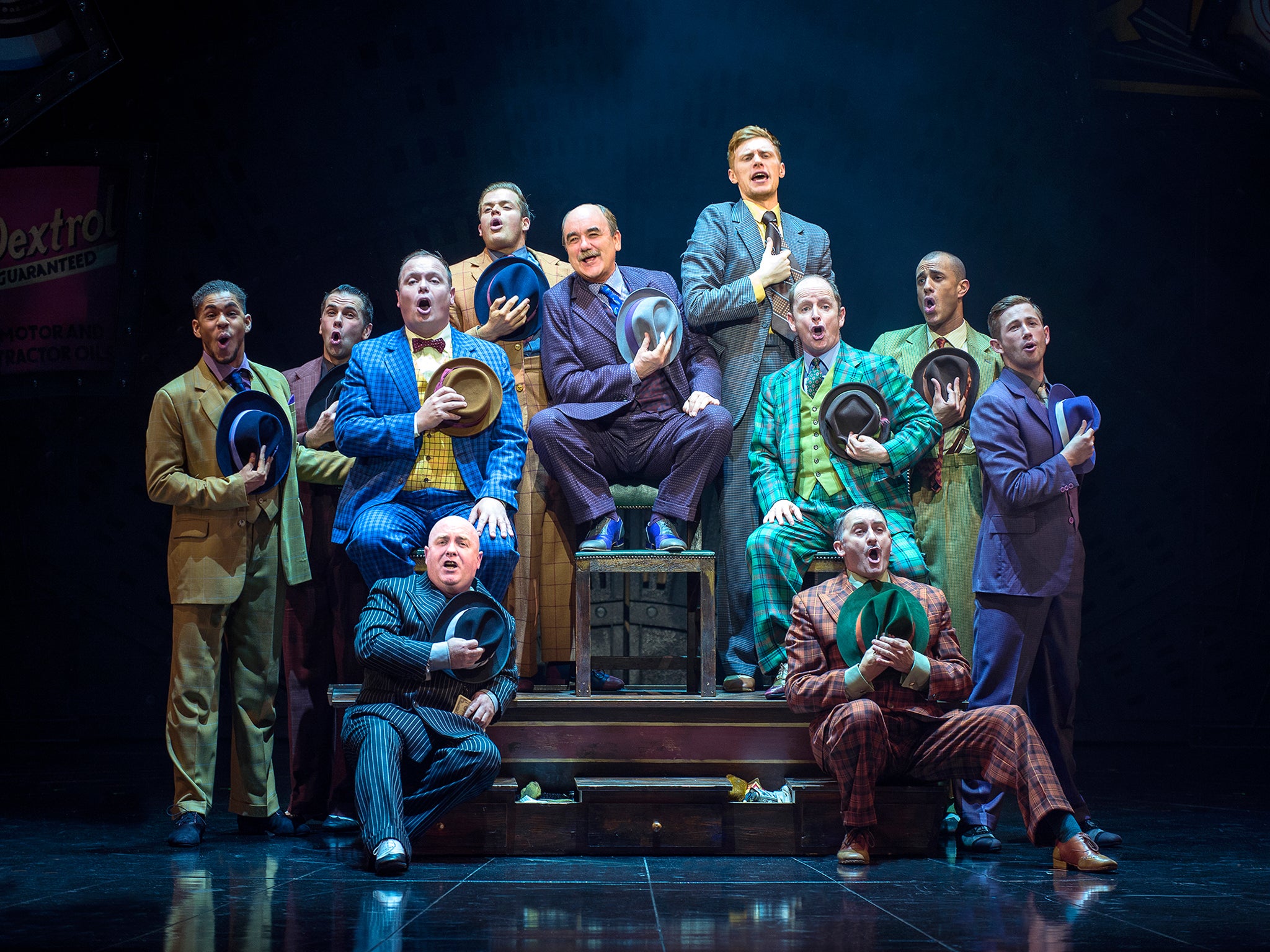
Guys
and Dolls is a musical based in the 1920’s whereas gambler
Nathan Detroit has few options for the location of his big and illegal craps
game. Needing $1,000 to pay a garage owner to host the game, Nathan bets
another main character named, Sky Masterson that Sky cannot get virtuous Sarah
Brown out on a date. Despite some resistance, Sky negotiates a date with her in
exchange for bringing people into her mission. Meanwhile, Nathan's long-time fiancée, Adelaide, wants him to go legit
and marry her. It
highlights a lot of religious use within the play.
The musical context behind "Sit down, you're rocking the boat":
Sit
down, you’re rocking the boat is sung by a character called Nicely Nicely
Johnson and expands the idea of him having a dream he had on his way to either
heaven or hell. The
boat highlights the journey through the pool of souls going to hell. This
song especially shows a massive part within the show as the it explores the
idea of being saved and forgiven for their crimes. Here's the song we are focusing on in dance class and the choreography:
I believe the suitable staging form would be "Proscenium Arch" staging as it would help with a lot of exits and entrances with the different characters. It would also be helpful as there isn't too much intensity within the audience and doesn't break the forth wall too much. I propose this type of staging would benefit the style of the play as it almost is within the split staging between scenes. My original idea was to perform on a Thrust staging however, I thought about the disadvantages the side audience would have as well as the actors exits and entrances.
Costume:
Red opulent clothing for the rich to represent power and a sinister twist to each of the character. It would also highlight an idea of poisonous within society and that everyone should beware of them. My idea of the costume design would be the context what I've read within the script itself. Although Nothing on Earth doesn't have any time period nor literal style of what characters would wear, I did look over the theme of Capitalism vs Socialism and the biblical knowledge of Noah and the Ark, I shaped the idea of old context and 1800's style.
Sound:
Early British music, Noah would have a subtle peaceful victory sound effect compared to the rest of his family would have an eerie climaxed setting. For example; when Mrs Noah enters onstage in the opening scene, I would use a dark and "rumbling" underscore to create that intensity for the audience to realise how powerful and controlling Mrs Noah is, every time she came onstage or when an intensity begin. In comparison to Noah, I would have a light melody to symbolise hope within the show as he's the main protagonist who isn't an evil spirit.
Props: The props I would use within one scene would be teacups to highlight the theme of a "posh" era as well as highlight the British "culture" whereas tea was a very expensive within the 1800s as it has a lot of historical context behind it.
Health and Safety:
Health and safety within the technical run is not as complex as you would imagine, however working around technical work can be dangerous. There's hazards where people may trip over, dark areas when onstage which makes you quite confused on where you're going, due to the theatre lights. In other words, to avoid all of this the technical team call this a call and response to ensure people on and offstage to be aware of their actions and surroundings.
If a show is being performed within a tech or dress rehearsal, and a blackout or fade is schedule, the phase "Going dark" is being said by one of the performance, it would be allow the technician to know that cue and as a response to that action, the performer would say "Thank you dark".
When using scaffolding/MEWP (Mobile Elevating Working Platform) it would be said ,"Going up" and "coming down"- all people in the space should move away from this area immediately on both calls to avoid things being dropped onto them.
Another key phase would be "HEADS"- This is when something from the rig/higher platform has or is about to drop or be dropped. Everyone on and offstage should be away from the working area but this still gives you a chance to avoid any dangers.
Finally, there's something named "Call times" which means-"Thank you 30", "Thank you 15", "Thank you 5" and "Thank you beginners"- This is all referring to you beginners call. Each number meaning how much time left until you have to make your way to your beginners positions. In other words, how the scene started.
Music Director: A music director manages the actors and the production, they are the main people to give direction on how the show/event must be presented onstage. Directors has the key role of choosing the cast members who sings what part, the style of the production design and creative aspect within the whole project.
Music Producer:A music producer is in charge of financial businesses, they hire the choreographer, music director, the composers to make up the whole crew to work around the production.
Choreographer: A choreographer is a person who creates abstract dance moves within any genre which fits within the music as well as the context of the production. For example: Cats is based on real life cats and the dance needs is based around jazz and ballet as cats are very flexible and easy to move your body.
Make up and Costume Designer:A make up and costume designer work within how the actors look to make the performance seem realistic. They're responsible for
Light and Sound Technician:A light and sound technician controls and helps set the atmosphere of the
Well Being within vocal practise:
Hydration:
Drink a lot of warm honey and lemon tea to sooth your vocal muscles as well as room temperature as it allows the voice to come out smoothly without the muscle straining. Diet: The diet within singing would be healthy food and no dairy products. The reason for no dairy is because the thickness of the dairy product will clog up your vocal airways and prevent your glands from opening. Use of muscles:
The main muscle would be your diaphragm as it allows the sound to travel and breathing within singing as well as taking deep breaths strengthens the muscle to hold out long notes and belt higher notes. Vocal exercise:
Here's some video's or me vocally warming up:
In this session, we focused on the topic of objectives and units within the lesson. Objectives include what the characters purpose and aim within the scenes, as units talk about the breakdown of scenes or parts of the scenes. For example; my object for Mrs Noah in the cake scene was to be over the top and leave a good impression. The units helped break down the scene into section where the mood would change or shift and sustain that reaction throughout.
Individually, we drew gingerbread men which represent the inside as emotion that their characters have within them and the outside is how they represent it towards everyone. This is also called the "Stanislavski system". We also looked at the practitioner name Stanislavski who focus on the naturalistic plays; for example, all the plays except Nothing on Earth is naturalistic as it's realistic and familiar to real life situations.
What went well within this task was how I broke up the scenes as mood changes and find the objective within the scene. Areas of improvement would be giving it more energy as well as understand the character more as I need to act more controlling and possessive with everything as well as be above everyone. My main struggle would be to learn my script so I can be more open to the physicality of the character- another thing would be how I would react to things as it's a melodrama and non-naturalistic.
This term, we are focusing on musicals as a unit and are looking at the musical Cats. Cats are based on a book by T.S. Eliot as it was composed by Andrew Lloyd Webber. The musical portrays a tribe of cats called Jellicles; by night, they make what is known as "The Jellicle choice" which allows cats to ascend to the Heaviside Layer and come back to a new life. Hence why cats have 9 lives.
In this session today, we began to learn a new song and split the harmonies into vocal ranges; my vocal range would be alto as well as soprano however, I decided to go with alto within my comfort zone.
What went well was I picked up the melody quite easily when I got the sheet music and was able to understand what I was reading and follow it with the accompany. Areas of improvement would be diction within the words and pronunciation of the word "Jellicles" within the pace of the song.
Within this term, we are focusing on the unit of musicals and the experience of musicals itself across the whole course.
We began looking at shows and was decided to do "Chorus Line" as a starter. We learnt a routine which was aspects from a video of the choreograph as well as improvised- majority of the dance moves were sections of ballet, jazz and physical theatre. This helped widen my knowledge of different dance types as well the limits I could push within my comfort zone.
What went well within these dance sessions, I was able to practise nonstop and understand each move step by step. I was able to add my own "sass" to make it quite my own and how I could play with it. Areas I may need to improve on would be my pace with the music, I would miss moves and would forget what comes straight afterwards as I wouldn't be use to the speed. I would also mess up my my correlation of my left and right and what way to go so the transition or travel isn't hard. One last evaluation would be being more balanced within the routine, as I'm trying to keep up with the music, the results and balance for majority of the moves aren't neat.
These are different types of stages within theatre.
Proscenium Arch: The metaphorical vertical space in a theatre, usually surrounded on the top and sides (whether or not truly "arched") and on the bottom by the stage floor itself, which serves as the frame into which the audience observes taking place upon the stage during a theatrical performance.
Advantages:
Allows to break the fourth wall
Space for orchestral pit
Always have to face the audience as well have them back
Wings for cast members
Disadvantages:
Engaging with audience is forced
Intensity is complicated and hard as you can't create a relationship with the audience
Actors doesn't always have the audiences eye line
Thrust Stage: This type of stage is extended into the auditorium so that the audience can be seated around 3 sides of the stage. Thrust is quite familiar with Proscenium Arch however aspects of this stage is different. For example; this has more of an intensity with the audience and the audience.
Advantage:
Acting can be more naturalistic due to having your back turned
Creates an intense atmosphere
Easy to block
Help actors feel immersed
Disadvantage:
Actors have limited exits and entrances
Can be seen from a 3D angle
Ensemble numbers may be difficult due to minimal space
Movement can be artificial for the actors as they keep moving to ensure they don’t have their back
to the audience for a long period of time
In the round: This type of stage is when the audience are in a circular seated position around the stage. Sometimes, the stage is lifted to make the audience see the event properly.
Advantages:
The audience feel included within the performance as it creates a intense and exciting atmosphere
Tactical experience with light and set
Foreshadow close to audience
Acting more naturalistic due to having to turn your back in large extension
Disadvantage:
Sight lines can be very tricky
No wings as such, limited exits and entrances for actors
Limitation of set design and props
More naturalistic lighting needed
Any set changes have to happen in front of the audience
Traverse: This type of stage allows the audience to face each other on either side whilst the event is being performed. This is also known as a "corridor" or "Alley" stage. Many fashion shows use this type of stage.
Advantages:
Creates an intense atmosphere
Projection can be easy
Unique experience for each side of the audience
Disadvantages:
Audience may feel intimidated
Audience may be distracted by each other on either side